02 Mar 2015
At Drawfolio, we strongly believe that the better publicity we can get is from a happy PRO customer. But we also want our PRO users to win when giving us that word-to-mouth, and that's why we are launching our Affiliates Program.
If you are a PRO user, you get a 20% discount for each friend referred by you that upgrades to PRO plan, and they get a 5% discount in their first year. If you bring 5 friends to PRO plan, your next year in Drawfolio is free.

You got all the info you need a the "Affiliate" section. There's two ways for you to bring your friends to PRO plan:
If your friends are not registered to Drawfolio, give them your unique registration link and we'll know they were referred by you. Bear in mind that they won't compute as a referred for you until the upgrade their accounts to PRO plan.
If your friends are already registered to Drawfolio, tell them to your unique referral code in the 'discount coupon' field when upgrading to PRO plan, and we'll know they were referred by you
For any doubt, question, suggestion or problem, please contact us at uservoice or write us at [email protected].

Illustration by Beatriz Adela
23 Feb 2015
If you know us a bit, you could guess that we were eager to interview Ramon Mascaros. Ramón is one of our first customers, and a great artist that works on illustration, 3D modelling, character development and a bunch of things more. He currently works at Frame Over Studio, where he also teaches at the studio's owned school, Primer Frame. One of the latest 3D projects Ramón worked on was virtually reviving George Harrison for this music video
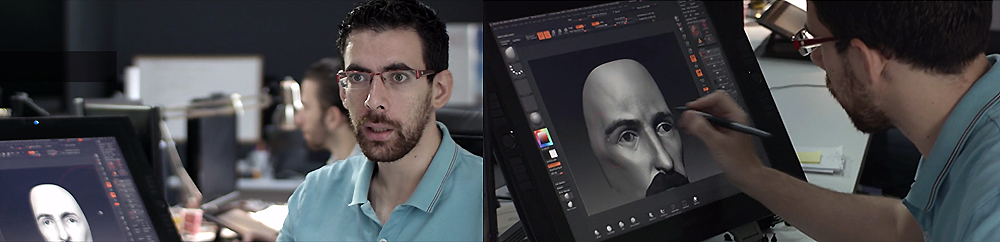
How did did the road began for you to get into illustration and 3D art?
I began purely as a painting artist, and focused on producing paintings, portraits, and making my way through exhibitions, contests and competitions. But I always had an interest on technology, and as a hobby of sorts I learnt about digital creation methods, including 3D modelling. Actually, the first proper job I got (through Leonardo Grant Program) was on the 3D industry, and I learnt a lot about the sector there.
When the crisis struck, I got to seriously re-think what I wanted to be and what I always was. I realized that I always had been doodling characters and I decided to focus on that, from character concept to their 3D sculpting. I didn't know back then if I would be able to make a living out of it, but I slowly discovered an exciting new world.
You moved from doing freelance projects to work on a studio and now teaching on a animation and modelling school. How was this journey? What did you learn from each stage?
As a freelance, I learnt to challenge myself and keep working even if I didn't got client projects, just to attain visibility and keep myself active. When you work on a bigger team, challenges come by themselves and that teaches you to finish every kind of job, even if you are not totally happy with it. I see this as a great way to becomer more efficient and going out from your comfort zone.
I have to admit that being a teacher has surprised me a lot. I ended doing it as a bit of an accident, but I have learnt way more teaching that when I was studying myself! There's quite a difference between knowing something to use it and knowing it to teach it.
This world gets bigger and more complex everyday, and you alone cannot get over much. It is not imperative to be in a team or group, but being connected to other professionals for help, ideas and support is what I value most nowadays.
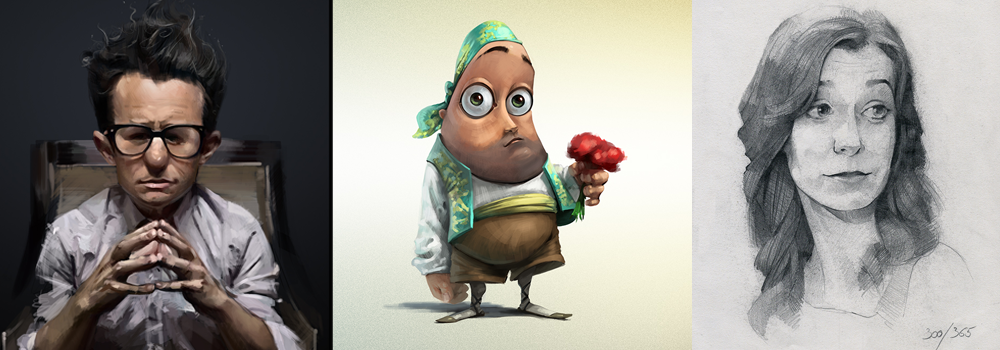
What role does social media and personal projects play for you when trying to build a personal brand?
I think social media is a must, it is the easiest way to make yourself visible around the world. It may not be the only way, but it is the most affordable for sure. Wether you are looking for clients or willing to work at a studio, you have to sell your product, and that product is you! I was once told that you need to work a lot, but also to make that work visible.
Personal projects will allow you to show your skills before having comissions, they will keep you active and, most importantly, you will shape the image you want to communicate. This will attract more paid projects and comissions related to your personal work: you will be shaping the market to your skills, and not be shaped yourself for the market (at least, not so much!).
What good (and bad) things do you feel the Internet and the new technologies have brought to the illustrator profession?
I'm very fond of technology, I've made my way far and fast with Internet and the democratization of tools it brought. Internet gives you access to instant information, new tools, trends or inspiration sources. It can make you more independent as a professional, giving you a distribution and communication channel.
But the same thing can be a disadvantage: there's so much information that it can be difficult to make yourself remarkable. There's not a lack of information, but disinformation because of the excess of it. News last shorter each time, you need to create more content to be truly relevant, but your audience also expects quality.
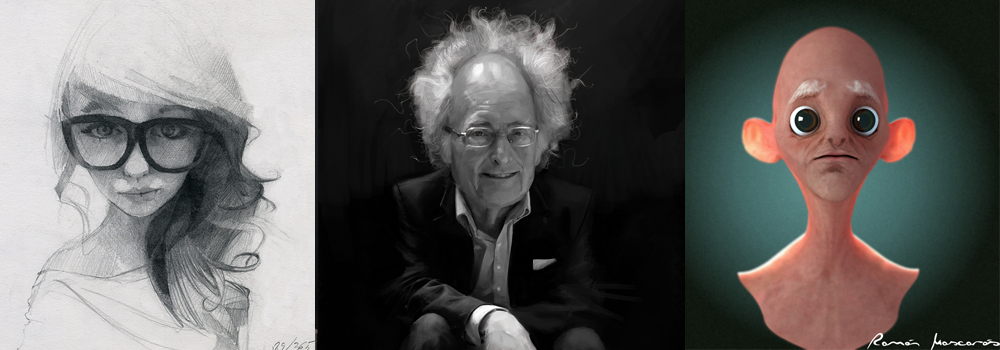
And last, but not least: any advice for aspiring illustrators just starting up their careers?
I don't think I'm good at giving advices, but I will try! There are no magic tricks: pick up an idea, ask yourself what you really want to achieve (this is a difficult) and let everything you do get yourself closer to that goal. Don't dispair, this is a an endurance race. If you don't fight for your dreams someone else will. You probably are who you want to be already, so let the world know. First is knowing what you want to do, second is realizing who you are already, and third is working to make it.
Thanks a lot, Ramon!
12 Feb 2015
Time to keep interviewing great illustrators! This time we had the great pleasure to talk with Mario García Arévalo, based in Valencia (Spain). As you will read through the interview, Mario has a powerful international projection, and has worked with brands such as Moët Chandon, Coca-Cola, Wacom, Warner Bros or Lipton UK.

How did you get into illustration? Where did the road to become a illustrator began for you?
I began drawing when I was a kid, but I got everything too diffuse in my life at that time. I enjoyed making all kind of drawings, from comics to portraits which I did never got right. I got into graffiti when I was 12 or 13 years old, I loved that way of expressing myself on the streets. After that, I began looking what happened around me and discovered other forms of expression, artists, exhibitions.. until I got to what I really like doing, illustration.
To be honest, I can't say when I got serious with illustration. It is said that your first paid project becomes a milestone in your life and career, and in 2012 I got to work on my first big publicity project for Moët Chandon.
You went through a lot of fields and diverse projects: illustrated albums, ads for big brands, and even apps and videogames. How was this journey, and what did you learn from each stage?
I sometimes feel amused with the reach of illustration myself, it has got into a lot of fields. We got illustration all around us, and I only noticed that when I began working as a professional. I began as visual developer for TV ads, and then I began to broaden my range to other fields like illustrated albums, text books (where I'm working right now), and the videogame world. The latter I can't now live without! I had never worked with such a team of great professionals, and I feel I now got and advantage from that.
I have felt comfortable in all the fields I've worked on, but I think publicity/advertising can be the toughest one: everything is so fast, deadlines are really tight, and projects are big to develop. But they are also the best paid works, although I prefer to be comfortable working and not dying from trying to reach a deadline (laughs).
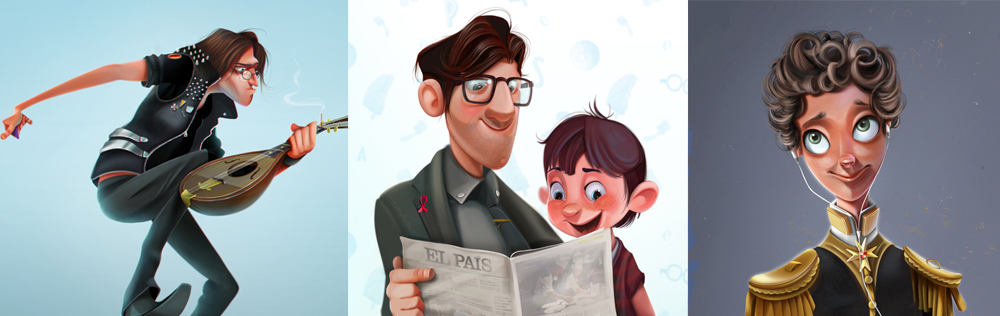
You worked in Switzerland and you also know very well other markets outside Spain, specially USA & UK. What are the differences, and what advantages and disavantadges have these markets?
When you work for other countries you always tend to do comparations between them, but you also have to bear in mind that one country brings different budgets and different ways to see the job. You can really notice that when comparing Spain to USA & UK. Spain may have lower budgets but also wider timing and deadlines, and you'll be more close to your client, to the extent of becoming friends with people in agencies and publishing firms.
In other countries budgets are higher, your effort is much more valued, but deadlines are also way more tighter. I'm very fond of working with clients from UK & USA, they have always been there for me and they always bring new challenges to the table. It's always a pleasure to work with them as they value a lot my style and the effort I put into projects.
What good (and bad) things do you feel the Internet and the new technologies have brought to the illustrator profession?
New technologies keep my work steaming! Internet is key for everything today, the 80% of projects I work on I got through email. We illustrators are also a big family and support each other on social media, which is a a great help.
And last, but not least: any advice for aspiring illustrators just starting up their careers?
I got asked a lot how can I bear with so much and diverse work, and I always like to quote Roosevelt: "Whenever you are asked if you can do a job, tell 'em, 'Certainly I can!' Then get busy and find out how to do it."
You cannot be idle in illustration: promote yourself in social media, do every kind of project you can, and build a great portfolio. It's the only way to make yourself remarkable among a large competition. Feeling related to what you are working on is the key to enjoy yourself when working.
Thanks a lot, Mario!
09 Feb 2015
When new PRO users arrive to Drawfolio, we always try to get to talk to them so we can improve. As usual, some common places arise from these conversations and end up becoming a reality, like the ones we are launching today.
Pages: You can now create pages and have text or links without the need of being attached to a gallery or pictures. In Pages you can create as many as you want and format their content with colors and styles. Your new pages will appear on your website navigation menu right after galleries.

More social icons: We made a lot more icons available for your social links, including deviantart, behance or patreon.

PDF download: You can now upload a PDF document with further information about you in the "PDF Download" tab of "Information". This document will be available for download to your visitors in the "About" section of your website.

For any doubt, question, suggestion or problem, please contact us at uservoice or write us at [email protected].
26 Jan 2015
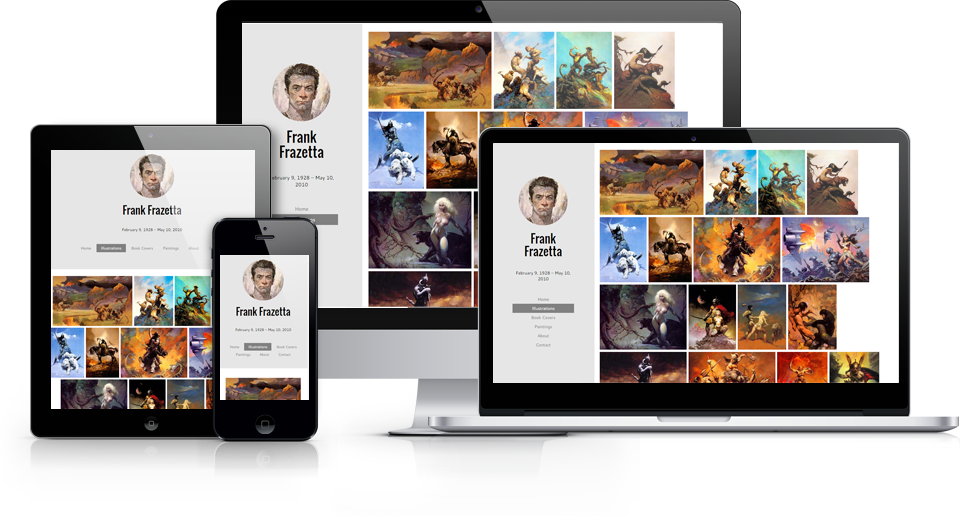
New year means: new templates! Last template we have been working on is named after huge artist Frank Frazetta, american painter and illustrator who changed the fantasy and science fiction genres forever.
On this new template we focused on achieving a minimal and elegant look with a compact image grid that preserves image's original aspect ratio. Hope you like it!
For any doubt, question, suggestion or problem, please contact us at uservoice or write us at [email protected].
