16 Apr 2015
Time to continue with our series of interviews! This time we talked with Neil Swaab. Neil is a freelance illustrator, art director, cartoonist, and writer based in Brooklyn, NY. He works on a great range of illustration and design projects, specially on the book and publishing sector. He has worked with clients such as Algonquin Books, Fleishman-Hillard, HarperCollins, AdultSwin/Comedy Central or Cartoon Network. He also runs Business of Illustration, a blog we just love, where he writes about the business side of things to teach aspiring illustrators how to kick-start their career successfully.

Where did the road to become a successful illustrator began for you?
I studied illustration in college and then began pursuing it immediately after I graduated. It took a long time (7 years) before I was able to do it full-time for myself. In the meantime, I worked as a designer and illustrated on evenings and weekends.
A big chunk of your work is on book covers. How did you end specializing on that? What does a project
need for you to be comfortable and happy with it?
Soon after college, I landed a job as a designer at HarperCollins, a large US publisher. That gave me a good understanding of the inner workings of the publishing industry and also provided a lot of contacts and education. When I left HarperCollins, I started to do freelance cover design for other publishers as well as illustrating the occasional book. Eventually, I started to get known in that area and book covers ended up being my bread and butter.
For me to be happy with a project, I need to feel like I’ve exhausted all of my options and truly settled on the one thing that I feel is the best. I like to explore a lot when I’m working on a project and never feel right about it if I haven’t looked at every variation.
You run a blog, "Business of Illustration", where you stress the importance of the bussiness side of things when building an art/illustration career. Do you think illustrators tend to neglect this, and why?
Not successful illustrators. You can’t be successful without knowing all of this stuff and all the best illustrators do. The blog is really more for aspiring illustrators and people at the early stages of their careers who are just trying to figure this all out. There’s not a lot of information about the business of illustration out there, so I wanted to create a resource that would have all the basic things an illustrator should know.
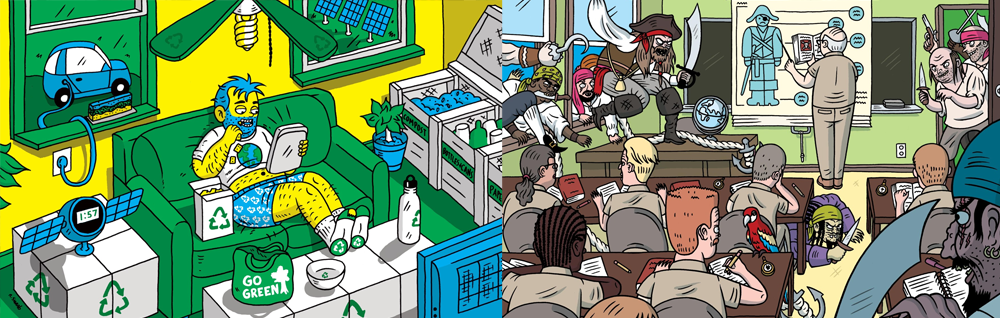
You just released a middle-grade book you both wrote and draw. Can you tell us more about this project, and where does it come from?
Yes, it’s a book that teaches kids how to get through middle school by doing some…let’s just say “dubious" things. It’s part novel and part guidebook, with tons of illustrations and comics. The book will be published on September 1st, 2015 through Abrams Amulet. I’m so excited for it. I’ve poured every bit of myself into it and think it’s such a cool, unique book. There will also be a follow-up to the book in 2016!
And last, but not least: any advice for aspiring illustrators just starting up their careers?
Talent only gets you so far. You’ve got to have drive and ambition. Keep working and putting in the hours and eventually you’ll get there.
Thanks a lot Neil!
13 Apr 2015
The templates you can choose for your portfolio website in Drawfolio always show pictures from a gallery in a grid layout, because it's for sure one of the easiest ways for a visitor to view your work in a glance. But there are some works that look way better showing picture after picture, as projects in your behance profile do. A lot of our users where asking us to incorporate this, so: here it is!
Now every gallery has two index styles: Grid (the default) and Project. You can change it Editing a gallery, setting up your prefered view the Index style selector and saving changes.

For any doubt, question, suggestion or problem, please contact us at uservoice or write us at [email protected].
01 Apr 2015
It has been a year since we ended our private beta and launched the public version of Drawfolio, and we felt like revamping the design of our home page to communicate our brand and values more effectively. Check it out and tell us what you think!

13 Mar 2015
We are going to America for our next interview, o maybe not that much. Daniel Gordillo is a Mexican artist now based in our home city, Valencia. He has worked on multiple fields: art, illustration, 3D modelling and animation, and web development. He is also one of the organizers behind Societat Valenciana de Blender, where he promotes the use of open source software among 3D artists.

How did did the road began for you to get into illustration and 3D art?
I've been drawing since I can remember, and it seems my interest on the less orthodox ways of art came factory-installed: when I was 5, I was already shocking the nuns from the catholic school I was at with my drawings. When I was 18 I began studying graphic design at Iberoamerican University, but I changed to Plastic Arts on Guanajuato University. I got my PROMOE grant there to come to Valencia and study at the Fine Arts School at Universidad Politecnica.
I've been in diverse art exhibition and projects since then, but I moved away from the art world in 2005, mainly because of my work at publicity and design. I'm now trying to get back to a more art-focused line of work, combined with my humble open-source software "evangelism" efforts.
I think the reason I ended on 3D art is that I needed to do more creative work than design and web development, but I didn't want to fully go back to the ART (with capital letters) circuit and galleries.
You work on diverse fields: art, illustration, 3D modelling and Web Development. Is it easy to combine the creative side with the technical side? Do you think that more artists should do that?
Nowadays, a lot of tasks on computer packages of animation, modelling or digital illustration can be automated via code, or you can create shapes and forms with parametric design that would be insanely hard to create "by hand" (well, if you can say "by hand" when talking about digital art).
It is not an imperative, but the artist who is not afraid to use maths and formulas has a terrific advantage from the rest.
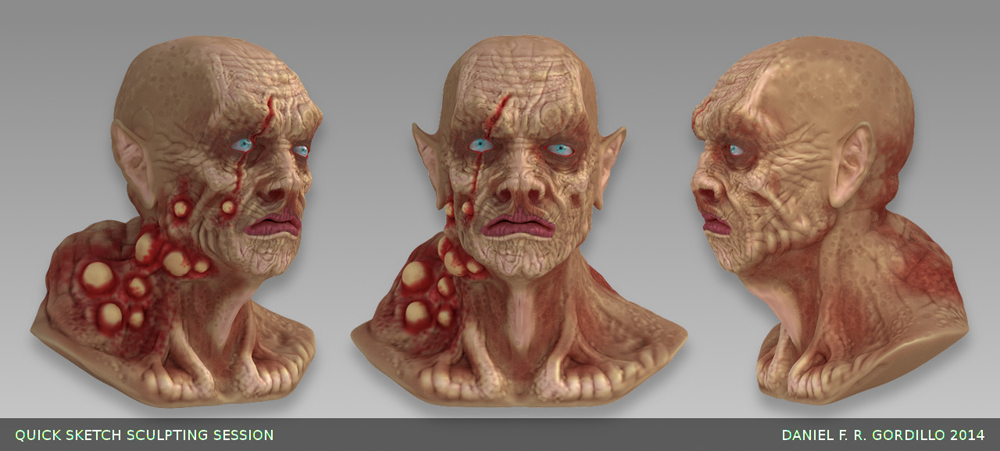
You were born in Mexico but you have been working for years in Spain. What differences did you find between this two markets for an artist to earn a living?
I've been lucky enough to be both in the art gallery world and the "industrial art" world (publicity and enterntainment). Spain has got exceptionally high level artists on animation, 3D modelling and illustration, and the CGI and videogame industry worldwide has noticed that. There are a lot of spanish studios designing videogames or making apps, and despite the economic crisis these have seemed to keep up.
But, it seems to me that to be this kind of "applied" artist is the only path in Spain to be respected and valued as an artist. Despite the "shocking" prices on events like ARCO, which the TV news remember us year after year, I always felt that in Mexico the artist was a lot more valued in society than in Spain. I can't say it happens everywhere in Latin America, but the plastic artist is even sometimes seen as a short of "shaman". But even if in Mexico the traditional art is quite a stable market, it has entered too late on the digital entertainment industry: most of the product is "imported", and there are barely news from mexican studios or companies working on that. But that is slowly changing!
What good (and bad) things do you feel the Internet and the new technologies have brought to your profession?
The good side is the biggest, no doubt: access to information, both the one you can get and the one you can offer. 20 years ago, Internet was just beginning and there were only a bunch of crazy people uploading their stuff on Angelfire, Xoom or Geocities. Nowadays, the amount of information you can get and the people that can see your work worldwide is just incredible.
The bad side: you sometimes forget about pencil and paper! You begin neglecting the things that are far from the screen, and this does not only happen to digital artists. The whole world is paying more attention to a small screen that lookin where they are walking. You have to disconnect from time to time.
And last, but not least: any advice for aspiring artists just starting up their careers?
Yes: don't stop learning. It is a fast evolving world and what is standard today can be obsolete in a year or a few months.
Thank you a lot, Daniel!
09 Mar 2015
If you work on illustration, you know Bologna's International Book Fair for sure. If you are coming this year, you already spent one or two months on preparing all your interviews you'll have there with editors and book publishers.
Having a professional portfolio website is the best weapon you can have to make those interviews become client work. Editors and publishers are going to talk with hundreds of illustrators during 3 days, and having a professional website where you can communicate a professional image and differentiate from others is key. With editors looking at so much illustration in such a short time, it is urgent to be remarkable.
But it's less than a month for Bologna's fair! If you are going and don't have a portfolio website yet, do not worry: you've got enough time. With Drawfolio you can build your own portfolio website in a few minutes, with no programming skills and with your own .com domain name. And we are doing a 20% discount in our PRO plan until Bologna's Fair begins.
Even if you are not coming to the Fair this year, we are doing you the discount anyway. Now it's the perfect time to begin building your portfolio website, create opportunities and conquer the Fair next year.

For any doubt, question, suggestion or problem, please contact us at uservoice or write us at [email protected].
