25 Sep 2017
As usual, we continue improving Drawfolio mostly based in conversations with our users. One of the things that kept arising lately was the possibility of having a slider in your site's home page, in order to grab more attention from new visitors.
Said and done! You will now find two new options at "Appearance" -> "General" -> "In portfolio home, show..." that allow you to show a slider with random pictures from your site, or the pictures from one of the existing galleries.

For any doubt, question, suggestion or problem, please contact us at uservoice or write us at [email protected].
29 Aug 2017
Today we have something special on our ongoing series of illustrator interviews. We talked with Collateral Damage Studios, an illustration studio based on Singapore, who apply anime and manga skills to projects with major brands like Microsoft, ImagineFX, or HTC. We hope you enjoy it!

Tell us a bit about Collateral Damage Studios. How was the illustration studio born, and why?
Collateral Damage Studios (CDS) started out as a hobby art circle with a group of friends. Over the years, by participating in conventions and doing freelance work, we expanded our circle to include a number of talented artists.
In 2013, Microsoft Singapore approached us regarding a concept artwork we posted online. Microsoft wanted us to develop our Inori Aizawa concept into a marketing campaign. However, we had to set up a professional corporate entity as an illustrator agency to work with them.
This opportunity came at the right time, when some of us were at a junction of our careers and wanted to go into the creative arts industry professionally. We took the the leap of faith and went ahead.
We are dedicated to creating opportunities for our fellow doujin and manga artists in Singapore, and delivering high-quality artworks for our clients around the world.
Who are the individuals behind CDS? Can you tell us more about your team and artists?
CDS is a doujin collective of talented freelance artists in formed around a core of full-time illustrators and a manager (myself). Many of us come from diverse career and academic backgrounds, and are self-trained in illustration.
Two of our lead illustrators are Low Zi Rong (WaHa) and Tan Hui Tian (Space Penguin).
Low is our lead character designer. He designed iconic characters such as Aizawa Inori (of Internet Explorer fame), Seika (the mascot for Anime Festival Asia), and the Princess of Orchids (a Singapore-themed princess for Japanese mobile game, Uchihime). He is also a talented animator who did the creative direction for animated shorts our studio produced.
Tan is a versatile illustrator who worked on some of our studio’s most significant projects, drew backgrounds for our animated shorts, and wrote a series of art tutorials.

You work for big firms and brands (Microsoft, ImagineFX, HTC), as well as small, indie projects.
What qualities does a client and project need to have for you to feel comfortable and motivated?
CDS is best known for our anime-inspired work. That said, we are seeking to grow our portfolio into new territories. Beyond straight-up anime art, we are taking up work that takes inspiration from North American or European comics.
An ideal project for us is one that challenges our capabilities to create something new, using our existing strengths.
And our dream client understands the needs of their illustrator, and gives constructive criticism to push an illustrator into producing his or her best. For me, there is a fine line between giving the illustrator just enough creative freedom to put his or her personal touch on the work, and ensuring that the final piece of work suits the original intent of the client. We are fortunate to have worked with a number of good clients who know how to navigate that fine line.
Of course, ideally, we’d love having ample time and budget to work with!
Can you tell us about the illustration and digital art industry in Singapore and Asia?
What differences do you find when trying to approach European or US markets?
The illustration industry in Singapore and Asia is already highly competitive. On top of that, since we tend to have weaker currencies compared to the US and Europe, our artists are able to offer our services globally at a slightly more competitive rate.
We’ve never been to Europe ourselves, but enjoy working with our Europe-based clients. ImagineFX commissioned us to do a series of workshops in six issues of their magazine. MAGE Company had us do artworks from steampunk airships to anthropomorphic cartoon rabbits for their board games. We would like to diversify our revenue sources and work with more European clients in the future.

As far as we know, you've got strong roots in the doujin and manga scene. How do you take those skills and make them be useful to companies and firms? What problems did you find in the process?
The doujin community is a competitive , always on the lookout for the latest trends and outdoing each other in terms of product offerings for our customers. Emerging from this competitive scene, CDS offers our clients our experience, skill, and versatility in creating art products that appeal to the latest consumer trends..
We continue to draw our talents from the doujin scene. Of course, it t takes some time train artist who were previously only exposed to the anime medium to new art direction. They might not be used to working based on a client brief. It gets trickier if the client’s target audience is not the usual anime consumer! However, over time and experience working with the rest of the team, the new artist can master a more diverse range of artwork.
And last, but not least: any advice for aspiring illustrators just starting up their careers?
Regardless of art direction, it is important to have a strong foundation in basic art concepts. This will enable you to adapt your preferred art style into various forms to fit different circumstances. Going back to the basics of art helps artists find problem areas and correct them.
Finally, do like us on our Facebook!
We will, thanks a lot!
26 Jul 2017
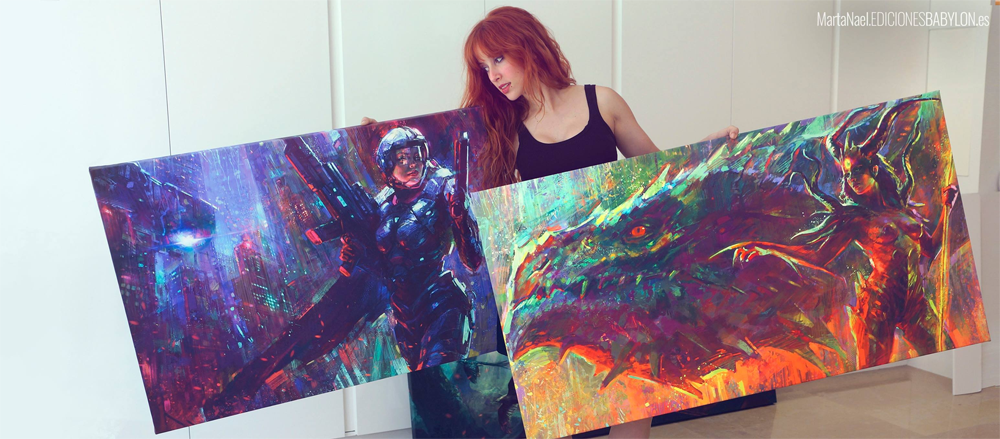
Keeping on with our interview series, we are very happy to bring you one of the best concept and matte painting artists in Spain: Marta de Andrés (also known as Marta Nael). Marta won the Expomanga award to best Spanish Illustrator in 2011, and in that same year, the Rising Stars Award from English magazine ImagineFX. She has worked in lots of comissions for book and music covers, and has published four artbooks with Babylon Editions.
Tell us a bit about yourself: How did the road began for you to get into art and illustration?
First things first, thanks a lot for interviewing me!
I feel that I have been drawing since forever, but my first memory drawing might be when I was five years old. At that time, a teacher told my parents to enroll me to an art school and I started experimenting with charcoal, oils, and color pastels. I remember that I always knew I wanted to study Fine Arts. That's where I met a professor that got me into the brush strokes technique, as opposed to line drawing, and to create stuff playing with light and color.
During the last year of my degree, I began to try out digital illustration and matte painting, and I had my first commissions soon enough. I began to work with Ediciones Babylon next year, and I’ve already published four artbooks so far.
Your style is quite unique, and you even called it "Digital Impressionism". Where do you find inspiration for your work, and how do you melt your sources of inspiration to create your own way of art?
Thanks a lot! Truth is, I discovered my passion for light and color thanks to this professor at Fine Arts. I worked more a more on these concepts and I tried to take the technique a step further, adding more saturated colors. That's where the "Digital Impressionism" thing comes from, since it’s mainly based on XIX century Impressionism.
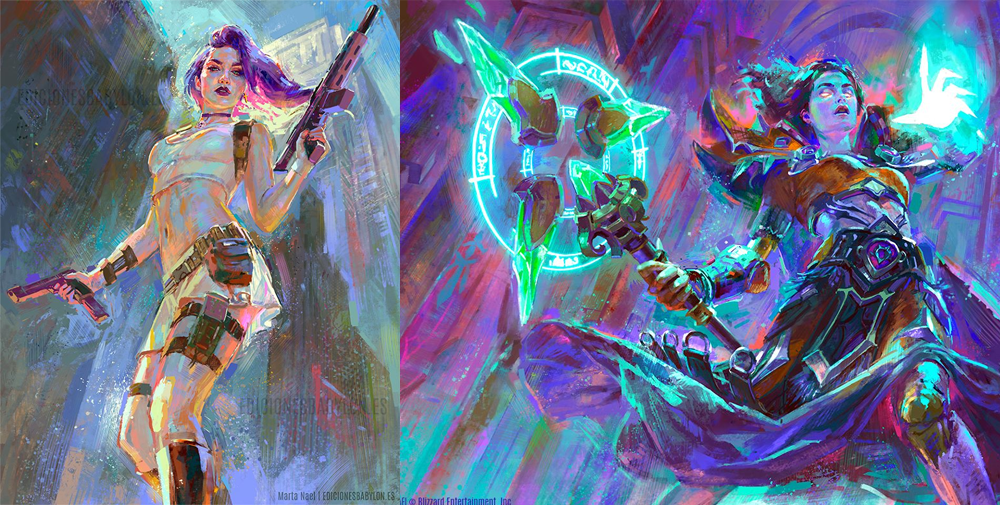
Sorolla has always been a great inspiration for me, but my work is also very influenced by Turner. From living artists, I would highlight Nathan Fowkes and James Gurney, for their use of light and color. But I actually follow a ton of artists with styles very different to mine.
I get inspiration from mostly anywhere: series or movies, books, or even while walking down the street you can get to see a unique light somewhere.
Talking about digital: can you tell us more about your process and how you blend digital and traditional techniques?
I always start by filling the whole canvas (be it digital or a real one) with a neutral color that is in the palette of colors I've got in mind for that particular piece. I try to play with complementary colors and color warmth, always using one color as an "accent" (due to its saturation or because it stands out from the rest) to highlight an element from the scene and make it the center of interest. Shapes are created by the contrast of light and color surfaces, in order to block in both the characters and the background.
I try to use both digital and traditional techniques, even if separately. If I've been doing digital work for quite a time, I need to get back to traditional techniques, and viceversa.
You've got a strong presence on Social Media. How do you manage your social networks, and how much time do you spend on them?
I try to spend on them at least one hour daily. It's not always an easy task to do because of the wide range of social media networks I'm in. I used to spend more time on Facebook before, but with the latest changes to their algorithms my content does not reach as many people as before. So I tried to open myself to other platforms such as Instagram, Youtube, or Artstation.
Each social media plataform is a little universe itself. There's always a format or way of telling things that's better for each one, or a time range where your content spreads better. I try to post updates on process and final pieces, or pictures from events I attend.

What good (and bad) things do you feel the Internet and the new technologies have brought to your field?
I think it's mostly positive. Without the Internet, I could only reach people next to me, dramatically decreasing my chances to find customers and get commissions. Thanks to the Internet, I can reach virtually any person, anywhere. Bad things about it come when people make a bad use of it. But professionally, I think it offers only advantages.
And last, but not least: any advice for aspiring illustrators just starting up their careers?
I always say the same thing: work, work, and work, and when you think you're done, keep working. I don't believe in being "gifted", but in hard, constant work.
On the other side, if you want something, fight for it and do not give up. But always try to be humble and critical with your work, while believing in yourself to reach what you want.
Thanks a lot, Marta!
04 Jul 2017
In our current interview series, we are trying to show insights from artists and illustrators, but also from the publishing firms who look for artists in their projects. We met with the founding team from Grafito Editorial (an independent spanish comic book publishing firm) in the last edition of the Splash Sagunt Comic Festival. We have been slowly cooking this interview since then, and finally, here it is! We hope you enjoy it.
Tell us a bit about Grafito.. How were the project and publishing firm born?
Grafito is the result of mixing two different groups of people. Some of us come from the fanzine and autopublishing world, and others from marketing and business. But all of us wanted to achieve the same goal: tell good stories via great spanish comic book artists. That's why we chose to publish to do our own production, and then license later to other countries. It's a lot of work, but we are very happy with the catalogue we managed to publish until now.
Who's behind Grafito? Tell us about the founding team and collaborators.
The two main "public faces" of Grafito are Guillermo and Yolanad. Guillermo Morales is on charge of the publishing and production side. This means looking and selecting projects, but also walking the authors during all the phases of the process. And, of course, everything related to printing and publishing.
Yolanda Dib takes care of marketing, communicacion, events, and international business development in order to sell licenses. But these two areas intersect a lot, and we like to agree on all decisions. It's a lot of teamwork, really.
We work with great professionals, too. Delfina Palma is our "license scout" and overall talent hunter. She is the illustrator who made all the branding for Grafito. Jesús Huguet works as layout designer in all our comic-books, and helps in lots of details with a great know-how as comic book artist.
What is the selection, edition, and publishing process of Grafito?
We are always looking for new titles in an active way. We are looking for autoconclusive stories that are about 100 pages long. If we spot an artist we like, we'll probably talk with her and ask her for more stuff.
We constantly look for new projects. A lot of them come straight from our website. We carefully tell there the guidelines to send us material (briefings, artists or writer's portfolios, etc.)
We don't really care if the authors are already well-known or not: we think their work has to speak for itself. And as we already work with a lot of writers and illustrators, we introduce each other to build teams.

What do you need from authors and artists to feel comfortable working together?
We like to work with creative, involved people who are willing to tell a good story and have the required discipline to meet deadlines.
Publishing a comic-book is only half of the work. Promoting both the comic-book and the author takes a lot of work in social media, talks, shop presentantions, and other events. This must be a joint work of the publishing firm and the author. We work together for a long time and usually end up being friends. We are lucky enough to say we enjoyed working a lot with all of our authors and artists.
You made a bet to publish both on paper and digital formats. How did the digital media changed the editorial world, in your opinion? How do you see the future of comic-books and editorial publishing?
Our goal from the very start was making our comic books available to as many people as possible, and that's why we also sell them in a digital, unexpensive (2,50€) version for the people willing to read in a tablet device.
But the average comic book reader is a natural born collector, and our main revenue still comes from paper comic books. A lot of innovative new formats have been seen these years, but still there's no silver bullet.
Spanish market is small if you compare it to other markets, like the French-Belgian market. But we've seen a rise of interest on people who usually do not read comics, thanks to the rise of graphic novels and also the current comic book movie adaptations.

Our business model looks getting out of Spain. We export stories to other countries to reach as much readers as we can. Actually, we are glad to announce we just sold four licenses to a frenc-belgian publishing firm (Buckson, ¡Socorro! Mi madre tiene Facebook, Cazador de Sonrisas y Arde Cuba). As this job need to visit international expos and fairs, we also began to work as agents for our authors.
And last but not least: What is being cooked right now at Grafito? What new stuff can we expect?
We've got some things beeing cooked in the oven. For starters, a main course: ARDE CUBA from Agustín Ferrer will be released in October. It is an adventure story that takes place in La Habana just before the Castro Revolution, told through the eyes of Errol Flynn's photographer: Frank Spellman.
We are also preparing a very diverse buffete: a spies comic with lots of Hollywood stars from the 50s, a historical adventure in the ancient Greece, and another magic/humor story. And also some others more from which we won't be telling any details (we have to keep looking mysterious and interesting, you know?).
Thanks Yolanda and Guillermo!
26 Jun 2017
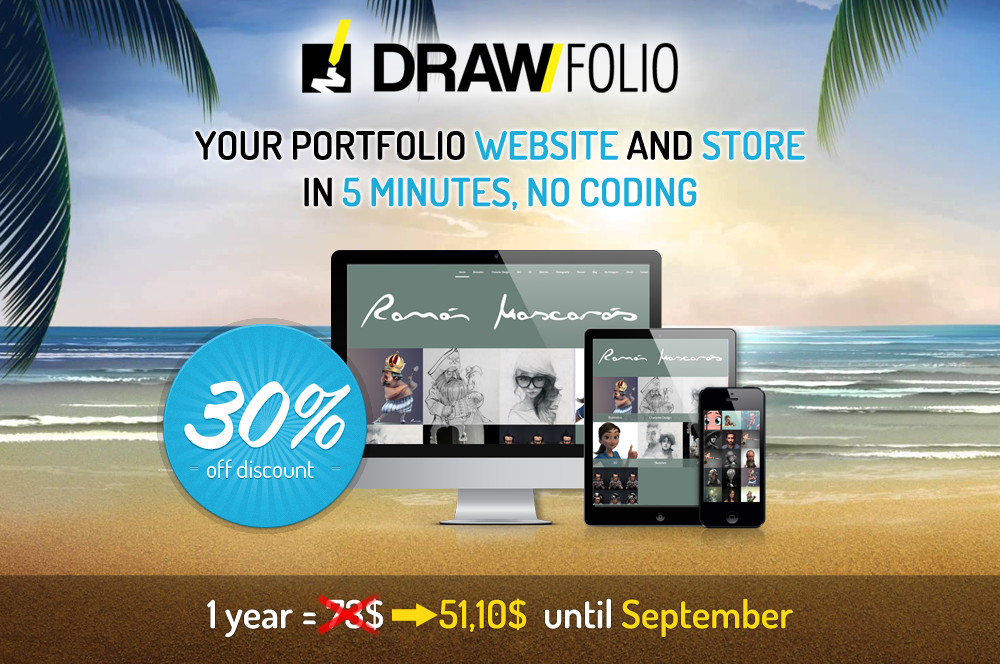
As it is traditional in Drawfolio during the summer months, we will try to fight the heat wave with the only thing we can do: discounts!
From this day to next September, you can have a 30% discount on your first year of PRO Plan, to make it more easy for you to have a great portfolio website that will get you opportunities and new customers.
You don't need to do anything special: the first year of all PRO plans will just cost 51,10$ instead of 73$.