11 Jun 2018
As you'll know after lots of email, the new European General Data Protection Regulation became mandatory a few days ago. Lots of our users did ask us if they had to do something about that on their portfolio websites. Although we are not legal experts, we are writing this blog to help you get informed about GDPR:
If you have a Drawfolio free acount, no action at all is required. In the regular, free portfolio websites at Drawfolio no personal data from visitors is captured. We do use cookies to analyse traffic and visits, but that is covered by our own privacy policy.
If you are subscribed to PRO Plan, but you didn't enable the contact form in your portfolio website, no action is required, as you are in the same situation described above.
If you are subscribed to PRO Plan and enabled the contact form in your site, then you'll notice we made some changes to comply with regulation. To contact with you through the form, people now have to enable this checkbox accepting your privacy policy.

And where can you edit the privacy policy for your site?. You'll see now a new item in the left menu of Drawfolio administration page: "Terms and Privacy". You can edit your privacy policy there. As you'll see, we already pregenerated one in spanish for you, and are currently working in an english version of it. It'll come soon!

For any doubt, question, suggestion or problem, please contact us at uservoice or write us at [email protected].
21 May 2018
Today, we are bringing an exceptional guest to our interview series: Juan Carlos Paz (also known as Bakea). Juan carlos works as a freelance art director, illustrator, and even sculptor. After years of working with some of the most important advertising agencies on Spain, Juan Carlos left all that behind to focus on illustration, and has developed a unique and personal style and universe of his own (Bakelanasland). We met Bakea at 2017's edition of Ilustrasal and we were eager since then to interview him for our blog.
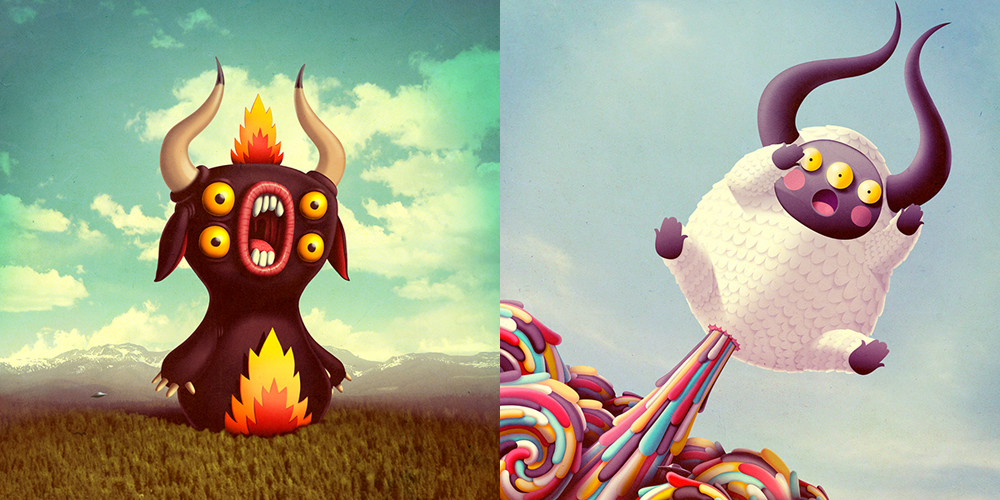
Tell us a bit about yourself: how did you end in the illustration and design?
Hi! I'm Juan Carlos Paz, I was born on Puertollano (Ciudad Real) on 1984, and I love drawing!
I've been drawing everything everywhere since I was a kid, so it was clear to me that I wanted to focus my career towards that.
When I finished art school, I opted for a college degree on Advertising and PR. After that, I worked for 5 years on big spanish advertising agencies, but came to realize that it wasn't what I really liked. So I began to draw more and more, and show my work on Internet, trying to work as a freelace illustrator some day. And luckily, I got there!
As you told on your talk on Ilustrasal 2017, your presonal projects evolved in some kind of "brand" that gave you a lot of visibility and brought clients, projects, and comissions. Can you tell us about how this happened?
Yes, I would say that it's more of a personal style rather than a brand, and that makes my work easily recognizable.
When I worked for advertising agencies, I was asked a lot to "copy" the style of different illustrators, and I realized how important having personal work and style is for an illustrator. Also, there's some work of experimentation and research to find a style you like and you feel comfortable with.
Who are your biggest influences and the artists you most look up to?
A lot of them! From current artists, I love Mark Ryden, Gary Baseman, Jack Sacks, Glanderco, Grand Chamaco. Also, being around friends who work on illustration inspires me a lot. Diaz Faes, Wearbear, or Nose, are friends but also very inspiring.
From classics, I love Grant Wood, Henri Rousseau, or Dalí.
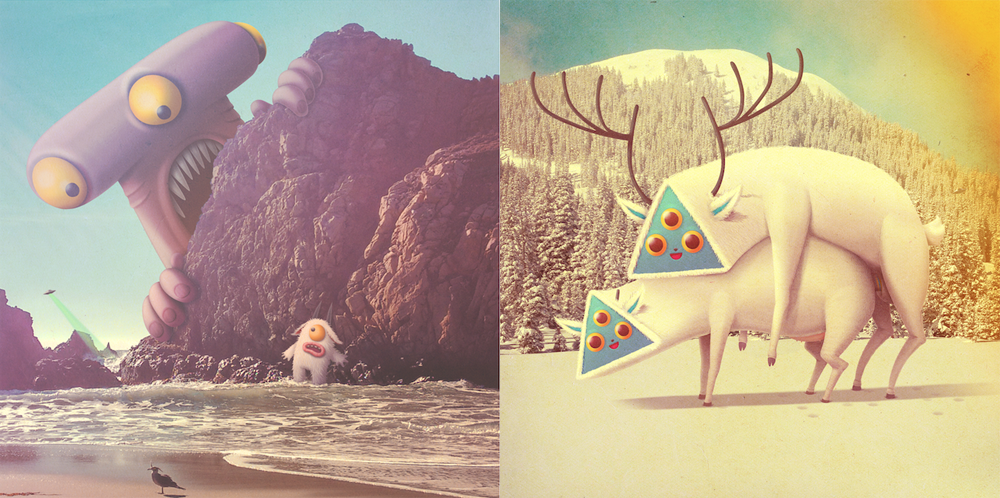
What qualities does a client and project need to have for you to feel comfortable and motivated?
The most important thing is that I need the project to be interesting. Being interested in a project makes everything more simple, and gets you more involved. When this happens, everyone works towards the same objectives, and the final result is always way better.
You've got a strong presence on Social Media. How do you manage your social networks, and how much time do you spend on them?
Well, not so strong, I would say! I invest less time on them than I should. Nowadays, social media is super-important and deserve a lot of attention. Because of my particular style, I take a lot of time to make each illustration, and that makes me post less than I would like.
And last, but not least: any advice for aspiring illustrators just starting up their careers?
Don't give up! You've got to experiment with different stuff, and look for a style that clicks with people, not only with yourself. I began drawing black and white Hell Angels and now I draw colorful monsters!
Thanks a lot, Juan Carlos!
02 May 2018
Following in our interview series, we bring you young talent Jhon Ortiz, who we had the pleasure to meet when he won the jury award of the Cinema Challenge we celebrated last year. Though Jhon's main focus is in 3D animation, as you'll see in the interview, he also works on 3D modelling, illustration, and other disciplines.

Tell us a bit about yourself: how did you end in the illustration and animation world?
I’m not sure of the moment I decided to become an artist. I always enjoyed painting and drawing, but I did it just for fun, I never connected it with a professional career. I remember watching the Saturday morning cartoons as a kid: Merry Melodies, Looney Tunes, and Hanna-Barbera where among my favourites.
I was a kid bqack then and knew zero about animation, they were just fun characters to me. I think everything changed for me when I first watched Toy Story: I knew what I wanted to become since that moment, even if it’s difficult to tell your family you want to earn a living with animation.
Even if I knew it was not my thing, I decided because to study journalism because I thought that way my parents would be less anxious about me having a degree, and would let me dot what I wanted after. At university I met a friend who was as mad as me about animation. I remember us going to a Motion Graphics course, and things flowing fast since then: one course led to another, and my will to learng grew more and more until leading me to 3D animation.
You work on a variety of fields: illustration, 3D modelling and animation, even some UX and UI Design. Is it easy to combine the creative side with the technical side? Do you think that more artists should do that?
John Lasseter once said that "art challenges technology and technology inspires art". I think both things, art and technology, walk hand in hand. Creativity is one of the most important skills of a human being. The technical side helps us execute and make real what we imagined, but I don't see it as two separate things, but as a whole process.
The skills I have in those diverse fields come from different situations, and each artist walks a different path and finds different obstacles. In my case, I always was a self-learner and being able to sketch, concept, model, and rig a character gave me a lot of freedom and independence.

Who are your biggest influences and the artists you most look up to?
I'm influenced by a lot or artists: Genndy Tartakosky, Nate Wrangg, Mike Yamada, Dice Tsutsumi, Gop Gap, Elioli, Julia Sarda. And I could go on! Nowadays, just opening instagram or pinterest makes you discover new great and talented artists.
How do you manage your social networks, and how much time do you spend on them?
I don't have a strong influence in social networks, and I usually post stuff when I got some spare time to illustrate. But I don't really schedule myself for it, there are times where I make stuff and won't post it. I don't try to keep it up-to-date, I just draw and post stuff for fun.
Finally, any advice to those who are starting to work in illustration and 3D art?
It's hard advising when I just got started! But I think what matters is to be constant. You've got to see things like a marathon, not a 100 meters race. Hard work wins over talent when the talent does not work hard! If you are passionate about it, don't stop working on that, and don't be afraid of asking what you don't know and don't be afraid to show what you do know: the most talented people I know are the humblest.
Thanks a lot, Jhon!
23 Apr 2018
Following on our now quite extense interview series with artists and illustrators, today we are bringing you Shycheeks! (or Sara). Shycheeks is from Valencia, our home town, and a true Drawfolio veteran (she is with us since 2014!). We love her work, so an interview in our blog was due. As you'll see, Sara mainly does digital illustration and comissions for books, events, or firms, and also her own production and items, which sells online and on art fairs.
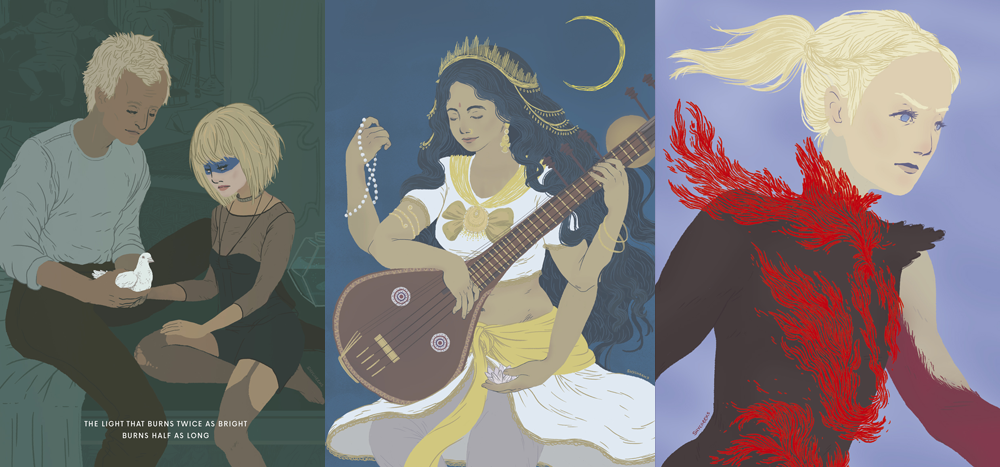
Tell us a bit about you. How did you decide to work in art and illustration?
I’m in love with comics and animation since I was a child so I never left drawing. I had the chance to do artistic studies in my hometown before university and then I went to Valencia to study Fine Arts. After that, a one-day workshop runned by Laura Pérez and Io Bru in Valencia was really inspirational and helpful to me as they told us a lot about how to start, build a portfolio, find clients and contact agencies, attend events, legal paperwork… All those important things that we need but wasn’t told in my university. A bit later I started to study illustration in ESAT where I found really interesting classes such as the Carlos Ortín and Malota ones. Ever since, I started my adventure of drawing, sending emails, attending events and meeting new people. Until now I’ve done commissions for books, events, little companies and videogames and now I’m spending most of my time doing my own merchandise and selling it at conventions and also online.
How is your process? Do you mix analog and digital tools?
In my early years doing Fine Arts I bought a Wacom Bamboo, so while I was mostly drawing with traditional tools, soon I got used to draw digitally even from the sketch. A lot of people doesn’t believe me when I say that I enjoy drawing most rather than painting. I use to draw everything a couple of times before starting to use color, but it’s true that I use to pay a lot of attention to my color palettes and I use a limited number of colors. I always use Photoshop and I’m the kind of person that uses lots of layers, but I try to keep them arranged in folders so I don’t get lost.
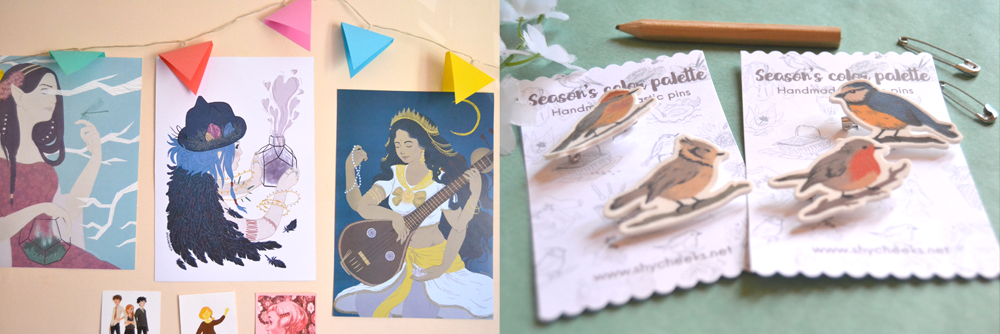
Who are your biggest influences and the artists you most look up to?
Recently I shared an influence map in my social media. I love the stylised characters and scenes painted by pre-raphaelites, artists like John William Waterhouse, Dante Gabriel Rossetti or Frederick Leighton. Now I see myself so influenced by the artstyle of Samantha Mash, Sara Kipin, Emily Carroll and Emily Cheeseman. I hope to draw illustrations as beautiful as theirs sometime.
Also, you are so active in social media. How do you manage that and how much time do you spend on it?
I like to pay attention to any new app, web or software, but it’s nearly impossible to spend time in all of them at the same time. While some time ago I was mostly using Facebook or Tumblr, now I prefer Instagram or Twitter. Or while I was using Deviantart and Behance some time ago, now I have more presence in Drawfolio and Artstation. I try to post on Instagram every two or three days and everyday in the stories, while I post the same on Twitter but with more interaction with other artists and friends. It’s hard to control what every algorithm wants from you in every social media, but most of them just wants you to be as active and using their possibilities as possible.

What positive and negative sides do you think the internet and new technologies have in your field?
On the positive side: to me as an introvert person helps me to reach and meet more people, to show my work anywhere and specially to find information about everything so easily. I don’t need to face anyone to get the email of an editor, I can ask directly to any artist how have they done anything or my illustrations can reach hundreds of persons in a day.
On the negative side: there is a constant pressure to keep posting and producing art content to share in your social media and there is a high risk to get addicted to earn more and more likes and followers. You must try to avoid that and focus on drawing and to not compare yourself with others. Also you must learn to deal with some people that doesn’t know the value and effort of what you do and came to you asking for free drawings or use your work with no credit or license...
Finally, any advice to those who are starting to work in illustration?
I encourage them to start showing their work with no fear even if they don’t have so much confidence yet. People like to see your work process and your art progression, not only finished works. I would say them not to undervalue their work and to help others understand the value of your work, time and effort. And specially I would say them to cheer their artist friends and send them lots of love!
Thanks a lot, Sara!
22 Feb 2018
At Drawfolio, we are always improving our product based on what you tell us. As you know, since quite a bit of time you can connect your instagram profile to show your latests images as a regular gallery in your portfolio site. But since instagram started allowing non-square pictures, a lot of people were telling us that the instagram galleries in their sites were not looking great in some templates of Drawfolio.
We worked to unify the look of the instagram galleries, and now they look great independently of the template you are using in your site.
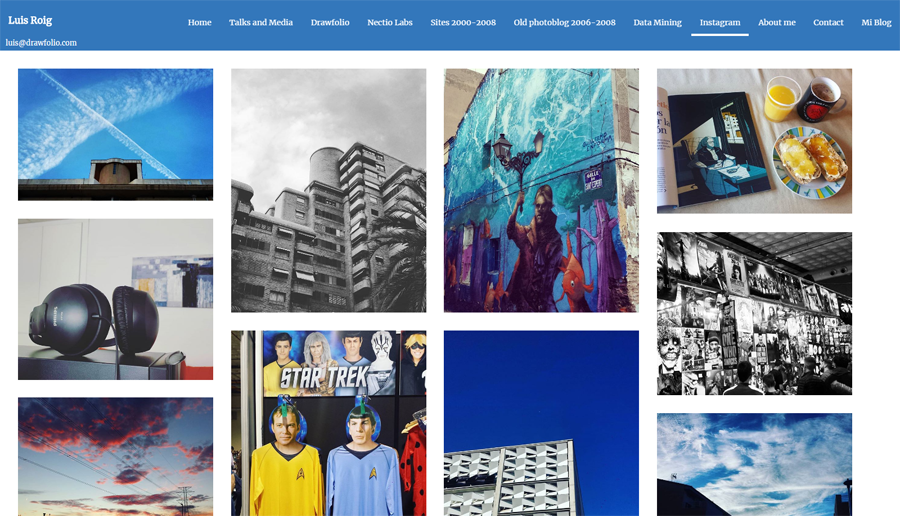
For any doubt, question, suggestion or problem, please contact us at uservoice or write us at [email protected].

